
Signs of a Compromised Skin Barrier: How to Repair It
Table of Contents
- What Is the Skin Barrier and Why It Matters
- Common Signs of a Compromised Skin Barrier
- What Causes a Compromised Skin Barrier
- How Long to Heal a Skin Barrier
- Skin Barrier Repair Ingredients That Work
- Your Damaged Skin Barrier Routine: Step-by-Step
- When to See a Dermatologist
- Conclusion
Last Updated: August 14, 2026
What Is the Skin Barrier and Why It Matters
Your skin barrier is the outermost layer of your epidermis, called the stratum corneum. It functions as your body's first line of defense against environmental stressors, bacteria, and moisture loss. Think of it as a brick-and-mortar structure: the "bricks" are dead skin cells, and the "mortar" is a mixture of lipids including ceramides, cholesterol, and fatty acids.
This barrier serves two critical jobs: it keeps harmful substances out and locks moisture in by preventing transepidermal water loss. When functioning properly, your skin feels smooth, hydrated, and resilient. When compromised, redness, sensitivity, dehydration, flaking, and acne-like breakouts often trace back to barrier damage, not to your skin type.
The acid mantle, a thin film of sebum and sweat on your skin's surface, maintains the pH balance your barrier needs to function. It's slightly acidic, typically between 4.5 and 5.5 on the pH scale. Disrupt this pH balance, and your barrier weakens almost immediately.
Common Signs of a Compromised Skin Barrier
A compromised skin barrier announces itself through specific physical symptoms. The challenge is distinguishing barrier damage from other skin conditions, especially acne, since the symptoms can overlap.
Physical symptoms to watch for
-
Persistent redness and erythema, Your skin looks flushed or inflamed, even without irritating products applied.
-
Stinging or burning sensations, Products that never bothered you before now sting. Water itself might sting when you wash your face.
-
Tightness and dryness, Your skin feels tight after cleansing. Moisturizer sits on top rather than absorbing. Flaking and visible shedding appear.
-
Sensitivity to everything, Your skin reacts to products it previously tolerated. Even fragrance-free, gentle formulas trigger reactions.
-
Roughness and texture changes, Your skin feels bumpy or uneven, and exfoliation makes it worse.
-
Increased breakouts or acne mechanica, Small bumps, pustules, or congestion appears, often where products touch your skin or friction occurs.
-
Visible dehydration lines, Fine lines appear or worsen, even in areas that don't typically show expression lines.
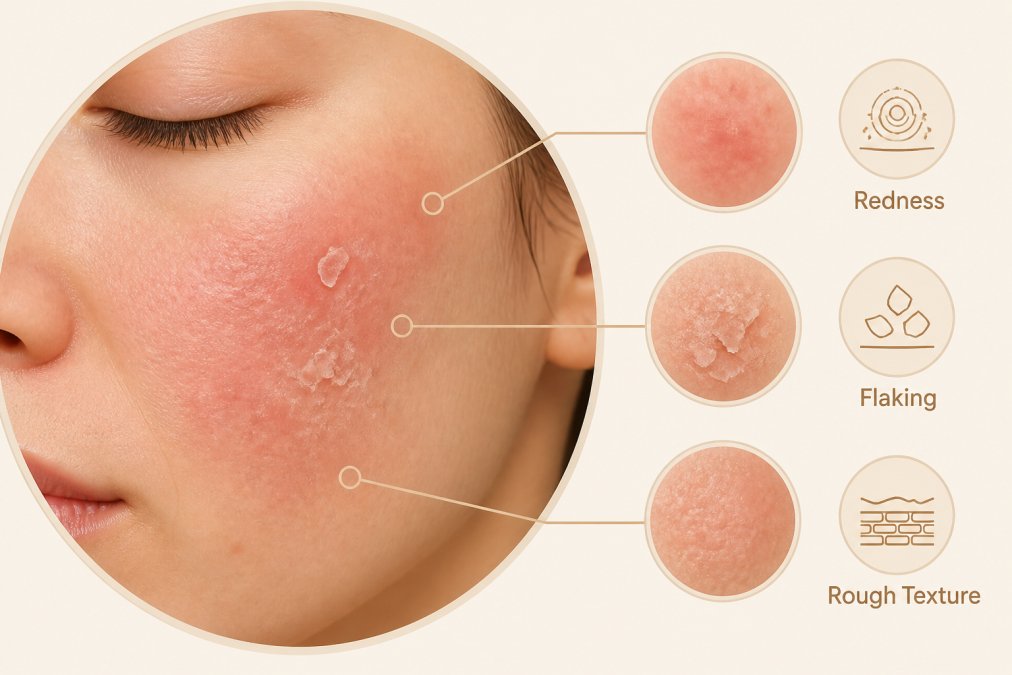
How barrier damage differs from acne
Barrier damage produces redness and sensitivity across a broader area of the face. The inflammation is diffuse rather than localized to specific comedones. You'll see flaking, tightness, and stinging. The redness improves when you stop using active ingredients and focus on hydration and occlusion.
Acne appears as distinct lesions, whiteheads, blackheads, or cystic bumps, in specific locations. The inflammation centers on individual pores. Acne improves with targeted treatments like salicylic acid or benzoyl peroxide, not with barrier repair alone.
The critical distinction: if your skin stings when you apply water or a basic moisturizer, you have barrier damage. If your skin tolerates hydration but shows localized inflamed lesions, you likely have acne.
What Causes a Compromised Skin Barrier
Barrier damage usually results from accumulated stress from skincare mistakes, environmental exposure, lifestyle factors, or a combination of all three.
Skincare mistakes that damage the barrier
Over-exfoliation is the leading cause of barrier damage. Exfoliating more than two to three times per week disrupts the skin's natural renewal cycle. Physical exfoliants are particularly harsh; chemical exfoliants are gentler but still risky when overused.
Retinoid irritation happens when you start retinoids too strong or too frequently. Starting with too high a concentration or using it nightly before your skin adapts causes inflammation, flaking, and sensitivity.
Stripping cleansers remove not just dirt but also the natural oils and lipids your barrier depends on. Foaming cleansers, hot water, and harsh surfactants all contribute. Your cleanser should feel gentle; if it leaves your skin feeling tight, it's too strong.
Mixing incompatible actives stresses your barrier. Combining retinoids with vitamin C, AHAs, or BHAs without proper spacing overwhelms your skin.
Skipping moisturizer or using the wrong type leaves your barrier vulnerable. If you're using active ingredients but not sealing in hydration with an occlusive moisturizer, your barrier dries out and weakens.
Lifestyle and environmental triggers
Climate stress accelerates barrier damage. Cold, dry air pulls moisture from your skin. Hot, humid climates can trigger inflammation.
Sun exposure without protection damages the lipid barrier. UV rays break down the ceramides and cholesterol that hold your barrier together.
Pollution and environmental irritants penetrate a weakened barrier more easily and trigger inflammation.
Stress and sleep deprivation impair your skin's ability to repair itself. Your barrier regenerates primarily at night; poor sleep disrupts this process.
Dehydration weakens barrier function. If you're not drinking enough water or your diet lacks healthy fats, your skin can't maintain proper hydration levels.
Over-washing strips your acid mantle. Washing your face more than twice daily removes the protective pH-balanced film your barrier needs.
How Long to Heal a Skin Barrier
Most people see noticeable improvement within two to four weeks of consistent, barrier-focused care. Full restoration typically takes six to eight weeks, depending on severity and your commitment to the repair routine.
Mild damage can improve in two weeks. Severe damage may take eight to twelve weeks. What matters most is consistency. Your barrier repairs itself through consistent hydration and protection, not sporadic intensive treatments. Missing a few days can delay progress.
During repair, avoid introducing new products or testing new actives. Your barrier needs stability, not experimentation. Simplify, don't expand, your routine.
Skin Barrier Repair Ingredients That Work
The most effective ingredients fall into three categories: humectants, emollients, and occlusives.
Ceramides, hyaluronic acid, and occlusives
Ceramides are the lipids your barrier is made of. When compromised, ceramide levels drop. Topical ceramides replenish this lipid layer and restore barrier integrity. Look for ceramide NP, ceramide AP, or ceramide EOP.
Hyaluronic acid is a humectant that draws water into the skin. It holds up to 1000 times its weight in water, making it essential for hydration. However, it only works if your barrier is intact enough to retain that moisture.
Occlusives seal everything in. Petrolatum, squalane, ceramides, and plant oils all function as occlusives. They prevent transepidermal water loss and give your barrier time to repair itself.
The most effective repair routine layers these three: hydration (hyaluronic acid), lipid replenishment (ceramides), and occlusion (a heavy moisturizer or oil). E'yn Skincare's approach combines these elements. The E'yn Veil No. 2 Hydrating + Barrier Repair Serum delivers hyaluronic acid and ceramides, while the E'yn Veil No. 3 Signature Moisture Seal provides the occlusive layer your barrier needs.
Ingredients to avoid when your barrier is compromised
Active ingredients (retinoids, AHAs, BHAs, vitamin C) are off-limits during barrier repair. These accelerate cell turnover and increase inflammation.
Essential oils and fragrance trigger inflammation and sensitivity. Use fragrance-free products only.
High concentrations of alcohol strip your barrier further. Avoid alcohol denat or SD alcohol near the top of ingredient lists.
Physical exfoliants cause mechanical damage. Avoid entirely until your barrier is fully repaired.
Vitamin C, benzoyl peroxide, and salicylic acid are too harsh during barrier repair.
Your Damaged Skin Barrier Routine: Step-by-Step
A barrier repair routine is simple by design. Complexity is what got you here. Simplicity is what gets you out.
Cleanse gently and skip active ingredients
Step 1: Choose a gentle cleanser. Use a cream cleanser or micellar water. Avoid foaming cleansers and hot water. Cleanse once daily (ideally at night) or twice if necessary, but keep it brief.
Step 2: Skip all active ingredients. This includes retinoids, exfoliants, and vitamin C. Your barrier is in recovery mode.
Step 3: Pat dry gently. Don't rub. Leave your skin slightly damp to help the next step absorb better.
Layer hydration and seal moisture
Step 4: Apply a hydrating serum. Apply to damp skin and press gently into your face. The hyaluronic acid draws moisture in; the ceramides rebuild your lipid barrier. Wait 30 seconds for it to absorb slightly.
Step 5: Apply a moisture seal. Follow immediately with a rich moisturizer or facial oil. E'yn Veil No. 3 Signature Moisture Seal contains occlusives that lock in hydration and create a protective layer your barrier needs to repair itself.
Step 6: Let it set. Wait a few minutes before applying sunscreen or makeup.
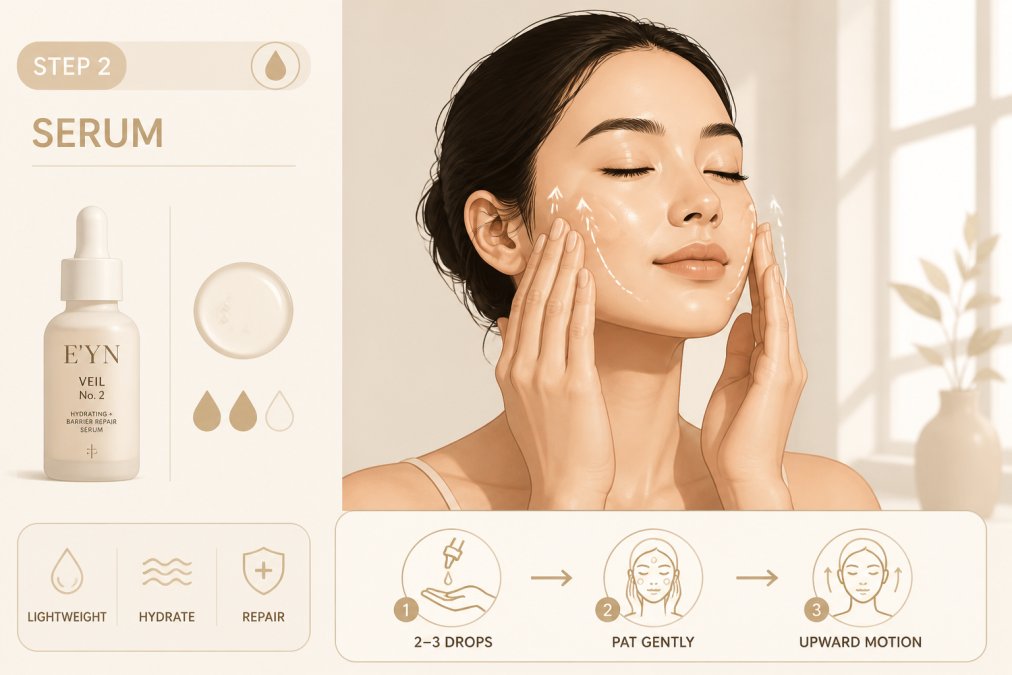
The minimalist approach to barrier repair
Morning: Rinse with lukewarm water only. Apply serum. Apply moisturizer. Apply SPF 30+.
Evening: Gentle cleanser. Pat dry. Apply serum. Apply moisturizer.
No toners, essences, or actives. Just cleanse, hydrate, seal, and protect. Most people see visible improvement in redness and sensitivity within one week. Flaking and tightness improve within two weeks. By week four, your barrier is significantly stronger.
Once your barrier is repaired, when redness has faded, stinging has stopped, and your skin feels resilient, you can gradually reintroduce actives. Start with one, use it once or twice per week, and monitor your skin's response.
When to See a Dermatologist
Most barrier damage responds to the routine and ingredients outlined above. But certain situations warrant professional evaluation.
See a dermatologist if:
- Your symptoms don't improve after four weeks of consistent barrier repair care
- Your skin develops severe reactions, hives, or signs of allergic contact dermatitis
- You have persistent pustules or cystic lesions alongside barrier damage symptoms
- Your skin shows signs of infection (warmth, swelling, pus, or spreading redness)
- You're unsure whether your condition is barrier damage or another skin condition like rosacea, eczema, or dermatitis
- You have a history of sensitive skin conditions and want professional guidance
According to the American Academy of Dermatology, persistent skin irritation lasting more than two weeks warrants professional evaluation.
A compromised skin barrier feels urgent because the symptoms are uncomfortable. But repair is straightforward: simplify, hydrate, seal, and protect. Remove the stressors, the actives, the over-exfoliation, and give your barrier time to regenerate.
The E'yn Veil No. 2 and E'yn Veil No. 3 are formulated specifically for this phase. They deliver the ceramides and hyaluronic acid your barrier needs without unnecessary ingredients that would slow healing. Get started with E'yn Skincare's barrier repair approach and see the difference in your skin within two to four weeks.
| Repair Phase | Timeline | Key Focus | Products |
|---|---|---|---|
| Early repair | Weeks 1-2 | Reduce inflammation, introduce hydration | Gentle cleanser, serum, moisturizer |
| Active repair | Weeks 3-4 | Strengthen lipid barrier, deepen hydration | Consistent layering, no actives |
| Consolidation | Weeks 5-8 | Stabilize barrier, prepare for actives | Maintain routine, monitor tolerance |
| Reintroduction | Week 9+ | Gradually add actives back | One active at a time, low frequency |
Frequently Asked Questions
Q: Can I use my regular products while repairing my barrier? A: Most likely not. If your barrier is compromised, your regular products are probably contributing to the damage. Pause everything except gentle cleansing, hydration, and sun protection. Once your barrier is repaired, reintroduce other products one at a time.
Q: How do I know when my barrier is fully repaired? A: Your skin no longer stings when you apply water or basic products. Redness has faded significantly. Your skin feels hydrated and resilient rather than tight or sensitive. You can tolerate gentle actives without irritation.
Q: Is barrier damage permanent? A: No. Your skin naturally regenerates every 28 days. With proper care, your barrier fully repairs itself. The key is consistency and patience.
Q: Can I use E'yn Veil No. 2 if I have oily skin? A: Yes. The serum is lightweight and designed for all skin types. Follow with E'yn Veil No. 3 in a thin layer; you need occlusion to seal your barrier, even if you're oily.
Q: What's the difference between barrier damage and dehydration? A: Dehydration is lack of water in the skin; barrier damage is breakdown of the lipid structure. Dehydration alone doesn't cause stinging or widespread sensitivity. Barrier damage causes both. Treat barrier damage with ceramides and occlusives; treat dehydration with hydrating serums.
Q: Should I use sunscreen while repairing my barrier? A: Yes, absolutely. Use a mineral sunscreen (zinc oxide or titanium dioxide) rather than chemical sunscreen, which can irritate a compromised barrier. Apply after your moisturizer. SPF 30+ is sufficient for daily protection.
Frequently Asked Questions
How do I tell if my skin barrier is compromised?
A compromised skin barrier shows distinct signs: persistent redness, stinging or burning sensations, tightness, flaking or rough texture, and sensitivity to products that previously didn't bother you. Your skin may feel dehydrated despite using moisturizer, and you might notice increased reactivity to environmental triggers like wind or cold. These symptoms occur because your skin's protective lipid barrier is weakened, allowing transepidermal water loss and irritant penetration.
How long does it take to heal a compromised skin barrier?
Most people see noticeable improvement within 2-4 weeks of consistent, gentle care. Full barrier recovery typically takes 4-8 weeks, depending on the severity of damage and your skin type. Patience is essential, rushing the process by reintroducing actives or harsh products will delay healing. Focus on minimalist routines with barrier-supporting ingredients like ceramides and hyaluronic acid during this period.
What ingredients repair a damaged skin barrier?
Ceramides, hyaluronic acid, and lipid-rich occlusives are the most effective barrier repair ingredients. Ceramides restore the skin's lipid matrix, hyaluronic acid draws moisture into the skin, and occlusives like glycerin and plant oils seal hydration in. Niacinamide supports the skin's natural lipid production, while centella asiatica (cica) and panthenol reduce inflammation and soothe sensitivity. Avoid actives like retinoids, vitamin C, and acids until your barrier is fully healed.
Can a damaged skin barrier cause acne?
Yes, barrier damage can trigger acne mechanica and increased bacterial colonization. When your skin's protective layer is compromised, bacteria penetrate more easily, oil production becomes unbalanced, and inflammation increases. This is different from typical acne: barrier-related breakouts are usually accompanied by redness, sensitivity, and stinging. The solution is barrier repair, not acne-fighting actives, which will worsen irritation and delay healing.
This article was written using GrandRanker