
SkinCeuticals Alternative for Sensitive Skin: 2026 Guide
Table of Contents
- Why SkinCeuticals Doesn't Work for Sensitive Skin
- Best Vitamin C Serum for Sensitive Skin: Stabilized Formulas That Don't Irritate
- How to Introduce Vitamin C to Sensitive Skin Safely
- SkinCeuticals C E Ferulic Sensitive Skin Reaction: What's Really Happening
- Top SkinCeuticals Alternative for Sensitive Skin: Product Comparison
- Long-Term Barrier Repair: Beyond Vitamin C
- Conclusion
Last Updated: August 3, 2026
Why SkinCeuticals Doesn't Work for Sensitive Skin
If you've experienced redness, stinging, or irritation after using SkinCeuticals C E Ferulic, you're not alone. The brand's flagship serum contains 15% L-ascorbic acid, a potent form of vitamin C that delivers impressive results for resilient skin but can overwhelm compromised barriers. The real issue isn't that your skin is "too sensitive", it's a formulation mismatch. Standard vitamin C serums were designed for skin that can tolerate aggressive actives. When your barrier is already compromised, adding a low-pH serum with maximum potency creates inflammation. Your skin doesn't need more power; it needs intelligence: stabilized ingredients, barrier-supportive compounds, and a pH that doesn't trigger irritation.
Best Vitamin C Serum for Sensitive Skin: Stabilized Formulas That Don't Irritate
The best vitamin C serum for sensitive skin uses stabilized forms like sodium ascorbyl phosphate (SAP) or 3-O ethyl ascorbic acid, rather than pure L-ascorbic acid. These derivatives remain chemically stable at higher pH levels, delivering brightening and antioxidant benefits without irritation.
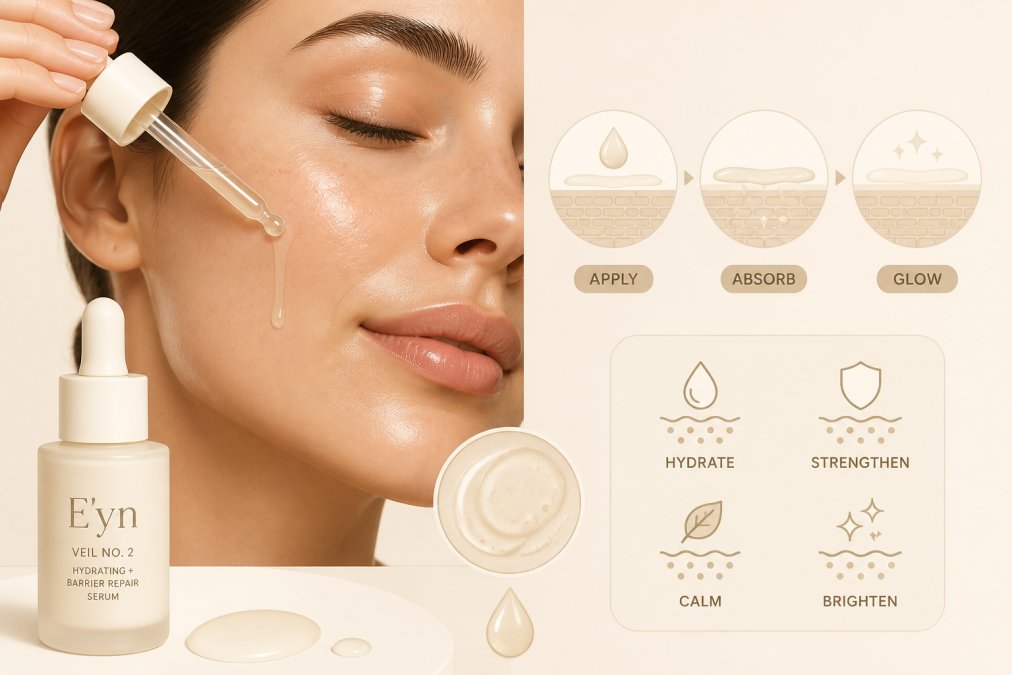
Stabilized vitamin C works at skin-friendly pH levels of 4.5-6.5, matching your skin's natural pH. L-ascorbic acid formulas typically sit at pH 3.5 or lower, creating an acidic shock that triggers inflammation and barrier disruption. The trade-off is real but manageable: stabilized vitamin C works slightly slower, showing results in 4-6 weeks instead of 2-3 weeks. For sensitive skin, that's worthwhile.
Sodium Ascorbyl Phosphate vs. L-Ascorbic Acid
Sodium ascorbyl phosphate (SAP) is water-soluble, doesn't require low pH to remain stable, and converts to ascorbic acid on your skin through enzymatic action. This gradual conversion reduces irritation while delivering antioxidant protection. L-ascorbic acid remains the gold standard for potency but requires pH below 3.5 to stay stable, oxidizes rapidly, and triggers significant irritation in sensitive skin. For reactive or compromised barriers, it's often counterproductive.
Concentration Matters: Finding the Right Strength
Clinical studies on vitamin C typically use 10-20% concentrations, but for sensitive skin, research suggests 5-10% stabilized vitamin C delivers meaningful benefits without barrier disruption. An 8% sodium ascorbyl phosphate serum will brighten your complexion and provide free radical protection without the irritation risk of a 15% L-ascorbic acid formula. Consistency matters more than potency: using a gentler formula regularly produces better long-term results than cycling between high-potency serums and recovery periods.
How to Introduce Vitamin C to Sensitive Skin Safely
Introducing any active ingredient to reactive skin requires a deliberate, slow approach. Start with patch testing on a small area of your inner arm or behind your ear. Wait 24-48 hours to see if redness, itching, or burning develops.
Once patch testing passes, begin with the lowest frequency: one application per week, in the evening only. After one week of tolerance, increase to twice weekly. After two weeks, move to three times per week. Aim for daily use only after your skin has shown consistent tolerance for at least four weeks.
Patch Testing and Barrier Assessment
Before introducing vitamin C, assess your barrier's current state. If your skin is already tight, stinging, or reactive to other products, pause new actives and focus on hydration and ceramide-rich products for 2-4 weeks. Once stinging stops, you can introduce vitamin C.
Patch testing reveals whether your barrier can handle the formula's pH and stabilizing agents. Some people react to preservatives or fermentation byproducts, not the vitamin C itself.
Layering Strategy for Reactive Skin
The order of application matters significantly. Never apply vitamin C directly to bare skin.
The optimal sequence:
- Cleanse with a gentle, pH-balanced cleanser
- Pat skin dry
- Apply a hydrating toner or essence to damp skin
- Wait 30 seconds
- Apply vitamin C serum
- Wait 2-3 minutes
- Apply a barrier-repair serum or lightweight moisturizer
- Seal with a richer moisturizer or facial oil
This layering dilutes the vitamin C concentration slightly, buffers the pH, and provides immediate barrier support.
SkinCeuticals C E Ferulic Sensitive Skin Reaction: What's Really Happening
When your skin reacts to SkinCeuticals C E Ferulic with redness, stinging, or burning, several mechanisms are at play.
pH Level and Ascorbic Acid Irritation
SkinCeuticals C E Ferulic has a pH of approximately 2.5-3.0, significantly more acidic than your skin's natural pH of 4.5-5.5. This acidity is necessary to keep L-ascorbic acid stable, but it triggers an inflammatory response in sensitive skin. Your barrier perceives it as a mild acid burn, increasing blood flow (redness), releasing inflammatory mediators (stinging), and upregulating sebum production.
For resilient barriers, this inflammation resolves within 30-60 minutes and triggers beneficial adaptations. For sensitive skin, the same inflammation creates irritation without adaptive benefit. A SkinCeuticals alternative for sensitive skin uses a higher pH (5.0-6.5) that doesn't trigger the same inflammatory cascade.
Ingredient Interaction Safety
SkinCeuticals C E Ferulic contains ferulic acid and vitamin E as stabilizing ingredients. For most skin types, this combination is excellent. For sensitive skin, it creates complexity: your barrier must process multiple actives simultaneously. Ferulic acid is itself a mild irritant in high concentrations. Vitamin E can feel occlusive on reactive skin. Combined with L-ascorbic acid's acidity, you're asking your barrier to handle three stressors at once.
A gentler alternative uses stabilized vitamin C alone or paired with only one complementary ingredient, typically hyaluronic acid or niacinamide. Check the ingredient list: if it contains more than four active ingredients, it may be too complex for currently reactive skin.
Top SkinCeuticals Alternative for Sensitive Skin: Product Comparison
Finding the right alternative requires matching the product's formulation to your barrier's current state.
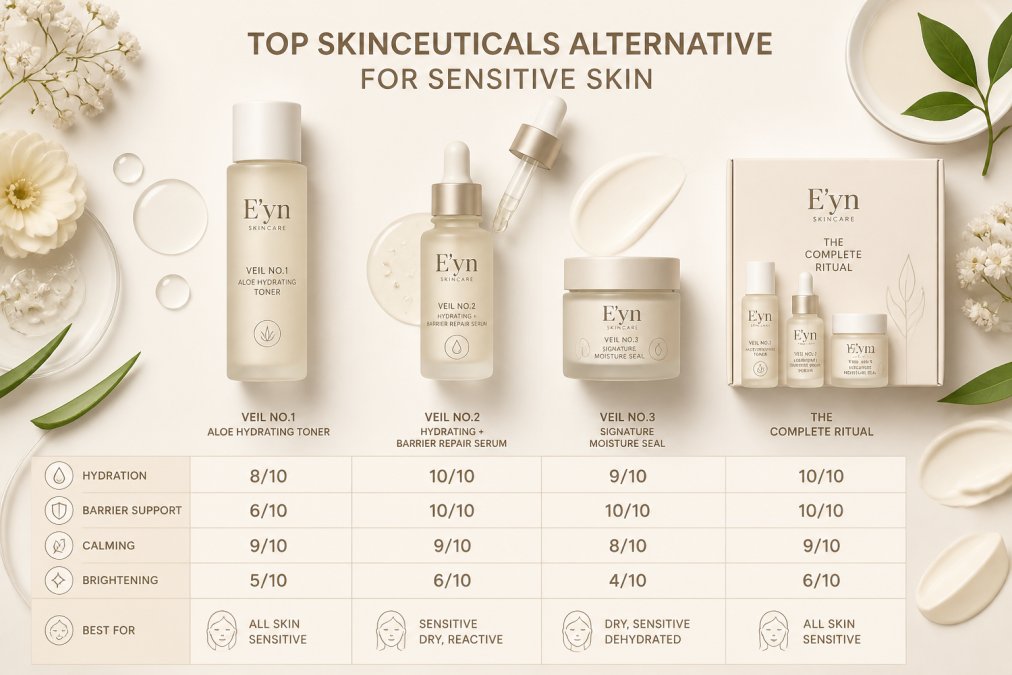
| Product | Form of Vitamin C | pH Level | Best For | Starting Price |
|---|---|---|---|---|
| E'yn Veil No. 2 | Hyaluronic Acid + Botanical Complex | 5.5-6.0 | Barrier repair + hydration | $32.00 |
| Mad Hippie Vitamin C | Sodium Ascorbyl Phosphate | 5.0-5.5 | Gentle brightening | $33.99 |
| Vichy Minéral 89 | Hyaluronic Acid (no vitamin C) | 6.0-6.5 | Hydration foundation | $32.00 |
| Paula's Choice CALM | Niacinamide + Ceramides | 5.5-6.0 | Redness reduction | $33.00 |
E'yn Veil No. 2: Hydration Without the Irritation
E'yn Veil No. 2 prioritizes barrier repair through hyaluronic acid and botanical actives that support skin resilience, ideal if your barrier is currently compromised. The serum works beneath the surface to visibly plump skin and smooth texture from the first application. For sensitive skin, it calms inflammation and reduces redness over time.
Pros:
- Visible plumping and smoothing from first use
- Strengthens the skin barrier
- Non-greasy, lightweight texture
- Calms sensitivity and reduces redness
- No irritation risk
Cons:
- Doesn't contain vitamin C, so won't address hyperpigmentation as directly
- Results are subtle compared to high-potency actives
Mad Hippie Vitamin C Serum: Gentle Brightening
Mad Hippie uses sodium ascorbyl phosphate at a concentration that delivers brightening without irritation. The formula includes ferulic acid, vitamin E, konjac root, and hyaluronic acid for antioxidant synergy and hydration. Ideal if your barrier is stable but you want brightening and photo-aging protection. Most people see visible brightening within 4-6 weeks.
Pros:
- Stabilized vitamin C without irritation
- Affordable
- Includes complementary antioxidants and hydration
- Suitable for sensitive and acne-prone skin
- Clean ingredient list
Cons:
- Lower vitamin C concentration means slower results
- May not deliver dramatic brightening of high-potency L-ascorbic acid
Vichy Minéral 89: Barrier Repair Focus
Vichy Minéral 89 contains no vitamin C but provides 89% Vichy Volcanic Water rich in 15 minerals. Ideal if you need barrier repair without active ingredients that could trigger irritation. The serum strengthens the barrier and provides immediate plumping through hyaluronic acid. Clinically tested on sensitive skin with only 11 ingredients, it's one of the simplest options available.
Pros:
- Minimalist formula ideal for compromised barriers
- Mineral-rich volcanic water
- Fragrance-free and clinically tested
- Immediate hydration and plumping
- Can be used multiple times daily
Cons:
- Doesn't contain vitamin C or other actives for brightening
- Primarily a hydrating booster
Paula's Choice CALM: Redness Reduction
Paula's Choice CALM targets redness through ceramides, prebiotics, and antioxidants. While technically a moisturizer, it's valuable for reducing inflammation before introducing actives. Use it for 2-4 weeks to establish baseline barrier health, then layer a gentle vitamin C serum underneath. Specifically designed for reactive skin, including rosacea-prone types.
Pros:
- Specifically formulated to calm sensitive skin
- Contains barrier-supporting ceramides and prebiotics
- Effectively reduces visible redness
- Suitable for eczema-prone skin
Cons:
- Rich texture may be too heavy for very oily skin
- Doesn't contain actives for brightening
Long-Term Barrier Repair: Beyond Vitamin C
If you've experienced irritation from SkinCeuticals or other potent serums, vitamin C isn't your immediate priority. Barrier repair is. Once your barrier is genuinely healthy, you can introduce actives safely.
Long-term barrier repair requires three components: ceramides to fill gaps, humectants to draw moisture in, and occlusives to seal everything. The timeline is 6-12 weeks, not days. Your skin's outermost layer renews every 2-4 weeks, but true barrier restoration takes longer. During barrier repair, avoid all actives except gentle vitamin C alternatives. Once your skin feels comfortable and non-reactive for a full month, you can begin introducing other actives.
Choosing a SkinCeuticals alternative for sensitive skin means prioritizing barrier health over maximum potency. E'yn Veil No. 2 delivers professional-grade hydration and barrier repair with visibly plumper, smoother skin from the first application, without the irritation risk of high-concentration vitamin C. Start with barrier repair, layer thoughtfully, and introduce actives only when your skin is genuinely ready. The results will be faster, more consistent, and actually sustainable.
Frequently Asked Questions
Why does SkinCeuticals C E Ferulic cause irritation on sensitive skin?
SkinCeuticals C E Ferulic contains L-ascorbic acid at a high concentration (15%) with a low pH around 3.5, designed to penetrate deeply. This combination is highly effective but also highly irritating for compromised or reactive skin barriers. The ascorbic acid form itself is more potent but less stable, and the acidic pH can trigger redness, stinging, and peeling in sensitive individuals. A SkinCeuticals alternative for sensitive skin typically uses gentler stabilized forms like sodium ascorbyl phosphate, which irritates less while still providing antioxidant benefits.
What's the best vitamin C serum for sensitive skin that won't cause irritation?
The best vitamin C serum for sensitive skin uses stabilized forms like sodium ascorbyl phosphate (SAP) instead of L-ascorbic acid, maintains a higher pH (above 5), and includes barrier-supporting ingredients like hyaluronic acid and niacinamide. Mad Hippie Vitamin C Serum uses SAP with ferulic acid and vitamin E, while E'yn Veil No. 2 prioritizes hydration and barrier repair over high-concentration vitamin C. Always start with lower concentrations (5-10% equivalent) and patch test for 3-5 days before full application.
How do I introduce vitamin C to sensitive skin without triggering a reaction?
Begin by patch testing on your inner arm or behind your ear for 3-5 days. If no irritation occurs, apply a pea-sized amount to clean, dry skin once or twice weekly, gradually increasing frequency over 2-3 weeks. Use it alone initially, avoiding other active ingredients like retinol or acids. Layer with a hydrating serum like E'yn Veil No. 2 or a rich moisturizer to buffer irritation. If stinging, redness, or peeling develops, stop immediately and allow your barrier to recover for 1-2 weeks before trying again at lower frequency.
Is E'yn Veil No. 2 a true SkinCeuticals alternative for sensitive skin?
E'yn Veil No. 2 is an alternative in the sense that it addresses the same concerns (antioxidant protection, hydration, barrier repair) but with a different formulation strategy. Rather than high-concentration actives, it prioritizes hyaluronic acid, barrier-supporting ingredients, and a pH-balanced formula designed for reactive skin. It's not a direct vitamin C replacement but a complementary serum that works alongside gentler actives. At $32, it costs significantly less than SkinCeuticals while offering hydration and sensitivity-calming benefits that make it suitable for compromised barriers.
What ingredients should I look for in a SkinCeuticals alternative for sensitive skin?
Look for pH-balanced formulas (ideally 5.5-7), hyaluronic acid for hydration, ceramides or niacinamide for barrier repair, and fragrance-free, paraben-free labels. If seeking vitamin C, choose stabilized forms (sodium ascorbyl phosphate) over L-ascorbic acid. Avoid essential oils, alcohol denat, and high concentrations of active ingredients. Ferulic acid and vitamin E are beneficial antioxidants when paired with gentle bases. Dermatologist-tested and clinically proven labels matter; look for products tested on sensitive or reactive skin specifically, not just general efficacy claims.
This article was written using GrandRanker